
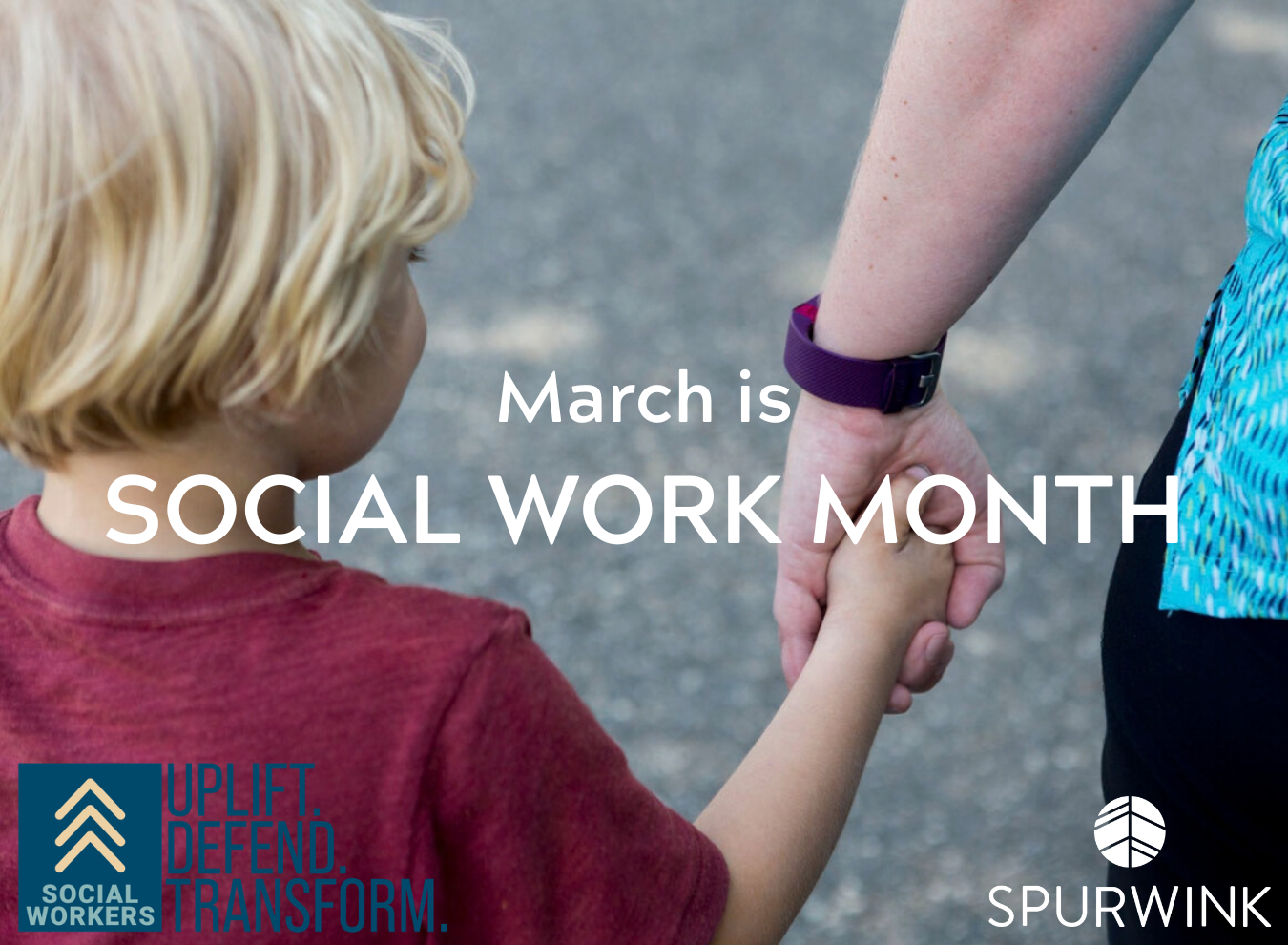
This March, we celebrate Social Work Month, honoring social workers in Maine and across the country. One of the five core mental health professions, social workers are professionals who, simply put, enhance well-being and meet human needs. In particular, many social workers help people who are vulnerable, oppressed, or living in poverty.
At Spurwink, social work is more than a profession—it’s a calling rooted in connection, compassion, and advocacy. Libby Derrig, Behavioral Health Home Program Supervisor and Licensed Clinical Social Worker with Spurwink, describes what the work truly means on a human level:
“Social work is about showing up—again and again—for people during some of the most challenging moments of their lives. At Spurwink, social workers meet individuals and families where they are, listen without judgment, and work alongside them to build stability, hope, and meaningful change. The work isn’t always easy, but it’s deeply human. Every day, I’m reminded that connection, compassion, and advocacy can truly make a difference.”
Libby’s experience reflects the heart of social work: supporting individuals, families, and communities through life’s most complex challenges. Social workers are trained in human development, behavior, and the social, economic, and cultural systems that shape people’s lives. They work across a wide range of settings—from schools and clinics to government agencies and community-based organizations—meeting people where they are and helping them build paths toward stability and well-being.
Social work is both a practice-based profession and an academic discipline. The driving motivations behind those who work in the field are to promote social change and development and empower people to live their best lives. Human rights, social justice, collective responsibility, and respect for diversity are key principles in social work.
Social Work Month has been celebrated since 1963, recognizing the important work social workers do in our communities. Let’s learn more about who social workers are, what social workers do, and the different career paths social workers can follow.
What are Social Workers?
Social workers are people who work in various ways to improve the lives of individuals, families, and communities. They have specific knowledge of and training in human development; behavior; social, economic, and cultural institutions; and the intersections of these factors. A variety of agencies and institutions employ social workers, from schools and government agencies to clinics and private practices.
In the US, social work is one of the fastest growing professions. As of 2026, there are around 810,000 social workers in the country. There are more clinically trained social workers than psychiatrists, psychologists, and psychiatric nurses combined.
Maine had about 7,613 licensed social workers in 2024—a large increase from 4,413 in 2019. Our state has one of the highest numbers of social workers per capita. In our complex, ever-changing world, there is a rapidly growing need for these licensed professionals in our community.
What Do Social Workers Do?
Broadly speaking, social workers help improve people’s capacity for social functioning and work to create the societal conditions that support those in need.
On the micro level, many social workers work directly with individuals and families to help them cope with a variety of challenges or life experiences, including, but not limited to:
- Abuse
- Disabilities
- Discrimination
- Disease
- Divorce
- Domestic conflicts
- Education
- Housing insecurity
- Loss
- Mental illness
- Relationships
- Substance use
- Unemployment
These social workers often help provide and connect people with psycho-social services, like counseling. Their goal is to prevent and manage crises as well as to help people cope with the stresses of everyday life.
On the macro level, some social workers conduct research, perform advocacy, engage in systems design or planning, and help develop policy. Hundreds of elected representatives on the local, state, and federal level are social workers.
Many social workers specialize in working with, researching, or advocating for certain populations, such as:
- Children and adolescents
- Individuals experiencing poverty or homelessness
- Individuals struggling with addiction
- Individuals who are incarcerated or in the criminal justice system
- Individuals with disabilities
- Couples and families
- LGBTQ+ community
- Medical patients
- Refugees and immigrants
- Students
- Veterans
How to Become a Social Worker
Interested in social work as a profession? Social work is broad field with a variety of career opportunities. Many different agencies and institutions employ social workers, including:
- Clinics
- Corporations
- Counseling agencies
- Elected offices
- Hospitals
- Mental health clinics
- Military
- Prisons
- Private practices
- Public and private agencies (such as Veteran’s Affairs)
- Senior centers
- Schools
Many social workers choose to become self-employed as Licensed Clinical Social Workers (LCSW), engaging in private practice.
While some entry-level positions only require a bachelor’s degree in social work (BSW) or a related field, many career paths require a Master of Social Work degree (MSW) and/or a social work license. Requirements for obtaining a social work license vary by state.
Becoming a Social Worker in Maine
In Maine, there are five types of social work licenses, with differing requirements. Each may involve earning a degree, passing an exam, and/or accruing hours of work experience.
- You can become a Licensed Social Worker (LSW) in Maine with a bachelor’s degree in social work from an accredited program, upon passing the Bachelor’s Examination.
- You can also obtain a Licensed Social Worker, Conditional (LSX) license in Maine, a non-clinical, entry-level license for those with a bachelor’s degree, enabling you to practice social work under supervision while you work towards your LSW.
- With a master’s degree in social work or social welfare from an accredited program, you can become a Licensed Master Social Worker (LMSW), which enables you to engage in non-clinical social work as a private practitioner in Maine.
- A Licensed Master Social Worker, Conditional Clinical (LMSW-CC) is a transitional license in Maine for LMSWs to obtain supervised clinical hours.
- A Licensed Clinical Social Worker (LCSW) license requires a master’s degree, passing of the Clinical Examination, 3,200 hours of supervised social work experience, and 96 hours of consultation in clinical social work—with this license, you can perform psychosocial evaluations, treat and diagnose mental illnesses and emotional disorders, and engage in private practice.
Learn more about becoming a social worker in Maine. If you’re interested in gaining social work experience for your career, check out Spurwink’s current job openings.
Support Social Workers in Maine
This year’s Social Work Month brings the theme of Uplift, Defend, Transform. Thank a social worker today for everything they do to uplift, defend, and transform our communities!
To learn more about the social and psychological services Spurwink provides, email us at info@spurwink.org or call us at (888) 889-3903.
